

Redemptive Reconciliation
The transforming power of freedom in Christ


A popular saying of the Me Generation of the Seventies went, “If you love something, set it free. If it comes back, it is yours. If it doesn’t, it never was.” Someone cynically edited it by adding, “…if it doesn’t come back, hunt it down and kill it.” That cynicism illustrates the essence of slavery.
Slavery centers around people and possessiveness. It comes in different forms and levels, from human bondage to indebted servitude to the inner enslavement of the soul. Whatever its form, slavery is slavery. Slavery dehumanizes a person by reducing them to an object.
Slavery has existed for thousands of years and is mentioned in the Bible. Some people question why the Bible doesn’t condemn slavery, seemingly accepting it. But this isn’t true.
The short personal epistle of Philemon refutes the idea that God approves of slavery, as does the book of Exodus.
Many of the activists for the abolition of slavery were people of faith who believed in God as the Creator of all humanity. That is still the case.
One of the more notable anti-slavery activists of the nineteenth century was William Wilberforce. He was a member of Britain’s Parliament and championed an Abolition of Slavery bill that passed three days before he died. His fight against slavery consumed him and his health for over four decades.
A little perspective
In the time of the New Testament, the majority of people in the Roman Empire were slaves in some form or another, and most of the Christians in the early church were servants or slaves because of poverty and inequality.
The Epistle of Philemon gives us some insight into how spiritually mature Christians viewed the plight of slavery in the context of the Christian faith. Here is how the Apostle Paul reasoned with a slave owner named Philemon, someone who came to faith through Paul’s ministry.
Maybe Onesimus was gone for a while so that you could have him back forever — no longer as a slave but better than a slave — as a dear brother. He is especially dear to me, but even more so to you, both as a person and as a Christian. (Philemon 15–16 GW)
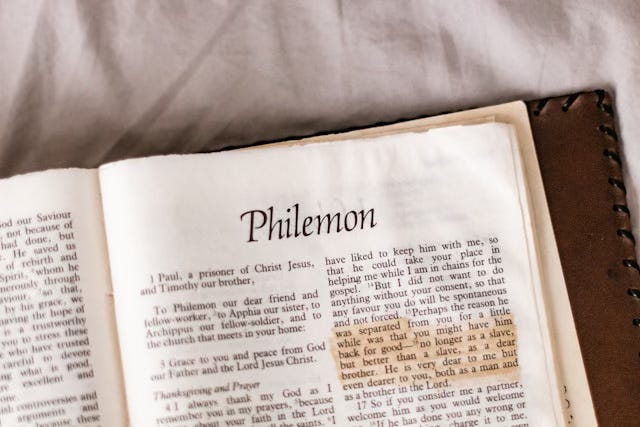
Paul’s appeal to Philemon
Paul appeals to Philemon as a follower of Jesus. A church met in his home that was the direct result of Paul’s ministry in Ephesus, a major city in ancient Asia Minor.
Paul makes the case that Onesimus, whose name means useful, is much more valuable than a slave. Onesimus is a man and a brother in the faith because of the work of God’s grace in his life.
Although Onesimus had stolen from his master (Philemon) and run away, he was now a changed person. God forgave and redeemed him, and Paul found him to be useful as a fellow servant in God’s kingdom.
Onesimus gained a new status and usefulness by becoming a fellow believer. He was a changed person, forgiven and redeemed by God.
Since Paul was the spiritual mentor of Philemon. Paul appeals to his brother in the faith to forgive and receive Onesimus, whom Paul raises to the status of his own child (Philemon 10). It is interesting how Paul focuses on the person redeemed by God from his slavery to sin and death, not the right or wrong of slavery itself.
His reasoning with Philemon, the former owner of Onesimus, is based on the equality all three men have in God’s kingdom.
The transforming power of God’s redemptive grace brings genuine freedom from all forms of slavery. This is the message every believer carries in their heart because of God’s gracious work in their life.
Philemon—a simple guide for reconciliation
This short epistle serves as a guide for reconciliation in a godly manner. It underscores the nature of genuine Christian faith—the power of the cross, the redemptive work of Christ—is more valuable and important than any cause, no matter how noble it is.
If you have experienced God’s liberating grace, reflect on how it has and how it can extend to others through you.
Are there people you see as inferior to you?
Do you hold resentment or unforgiveness toward anyone?
Who can you extend forgiveness or kindness to?
Choose to be intentional and gracious towards those you encounter this week, especially if they have wronged you.
Remember Paul’s loving appeal to Philemon for his former slave, Onesimus. Even though we might view Onesimus as a criminal, God’s grace set him free.
We, every follower of Jesus, ought to be more like Onesimus than Philemon. This is how Jesus sees us when we receive His forgiveness.
This reflection on redemptive reconciliation is very meaningful because it shows how the grace of God has the power to restore relationships and bring true freedom to the human heart. It reminds us that reconciliation in Christ is not only about forgiveness but about seeing one another as brothers and sisters transformed by His mercy. The Bible teaches in 2 Corinthians 5:18 that God has reconciled us to Himself through Jesus Christ and has given us the ministry of reconciliation. When we experience His forgiveness we are also called to extend that grace to others. Ephesians 2:14 reminds us that Christ Himself is our peace who has broken down the walls that divide us. This shows that true reconciliation comes through the transforming work of the cross. It also challenges our hearts to let go of pride resentment and control and to walk in humility and love. Colossians 3:13 encourages us to bear with one another and forgive as the Lord has forgiven us. Romans 12:18 also teaches us that as much as it depends on us we should live at peace with everyone. This kind of obedience requires patience prayer and a willingness to trust God with the outcome. When we choose reconciliation we reflect the character of Christ and open the door for healing hope and renewed fellowship. May the Lord help us to walk in love truth and unity so that our lives become a testimony of His redeeming grace each day. 🙏📖✨
Excellent meditation. The world could use a little of Philemon in its relationships right now.